Interview
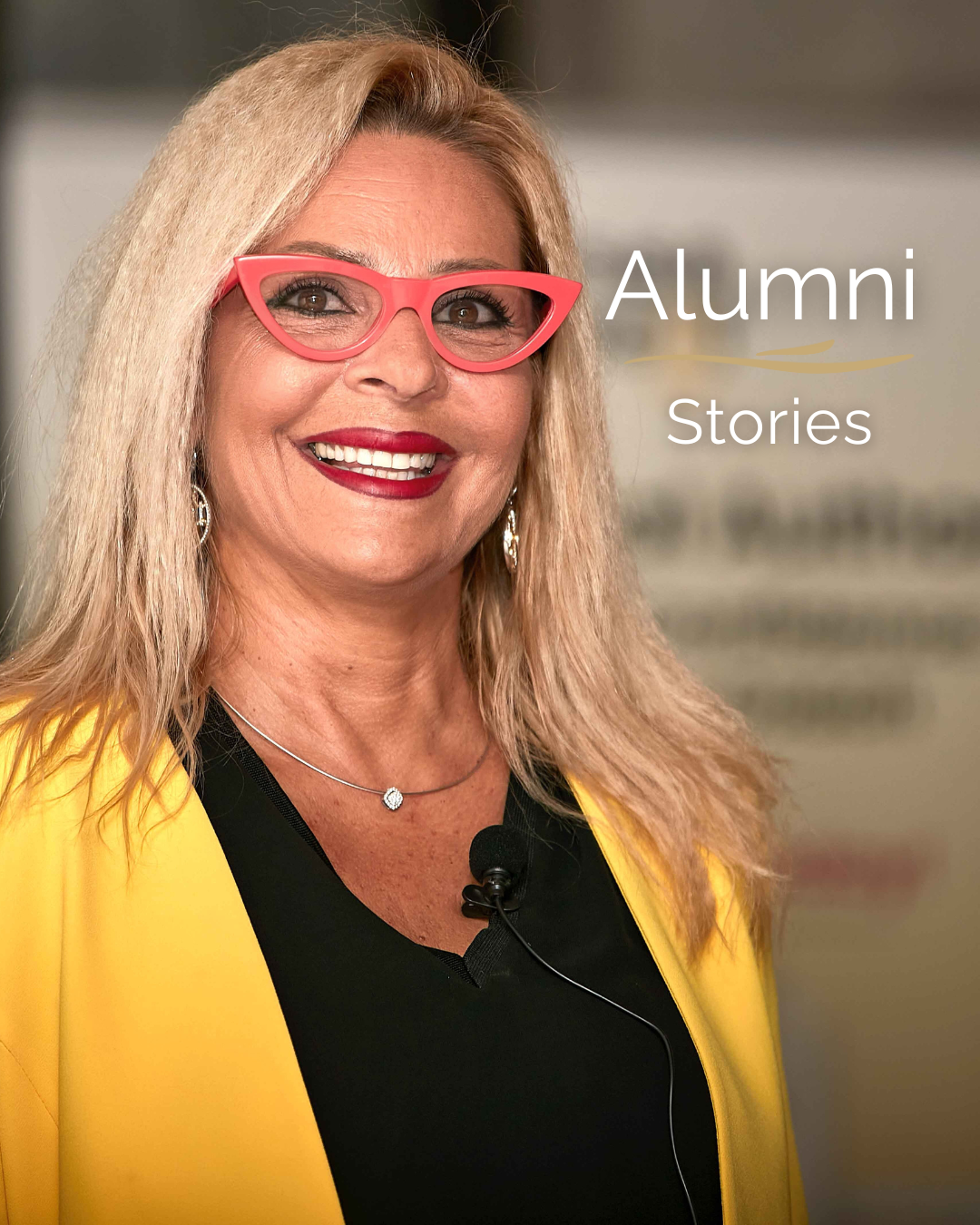
Larissa Redaelli
From her daring career to the creation of the “Happydemic Leadership” concept, and her commitment to women’s empowerment in the Middle East, Larissa embodies a new generation of leaders: human, authentic and committed.
What if tomorrow’s leadership placed people at the heart of performance?
A graduate of the École Hôtelière de Genève in 1992, Larissa Redaelli لاريسا ريدايلي has traveled the world, led, trained, transformed… until making her expertise a real lever of impact within organizations. Today, she accompanies companies and leaders in their quest for alignment, meaning and sustainable well-being.
Discover her powerful, unfiltered, inspiring testimony at the crossroads of hospitality, benevolent leadership and human transformation.
Can you tell us what motivated you to join the École Hôtelière de Genève, and what are your most vivid memories of your time there?
I joined the École Hôtelière de Genève after an eventful life. Of Swiss and Lebanese origin, I had to flee the war in Lebanon at the age of 18. At the time, I was destined for a career in special education, with a deep desire to help others. But it was in Egypt, while working in tourism, that I had a revelation.
Observing the world of hospitality, I was fascinated by the beauty of service, the attention to detail, and above all by the richness of human contact. The idea of being able to create genuine bonds with customers from all over the world touched me deeply. I realized that I could put my empathy and intuition at the service of a job that is close to my heart.
That’s how I discovered the École Hôtelière de Genève. I was looking for a recognized French-speaking school, and as soon as I discovered the EHG, it was an obvious choice. I was seduced not only by its reputation, but above all by what the school exuded: a place of excellence, openness and humanity.
I arrived with no experience of the hotel business. I had to learn everything from scratch, with great rigor. It was a difficult start, but I persevered and finished second in my class. That’s when I discovered my true vocation.
For me, the EHG is not just a school. It’s a home, a refuge. Having no home base in Geneva, I was kindly welcomed by the directors at the time (Mr. and Mrs. Weissenberg), who allowed me to live in the school itself. This unique experience left a deep human and emotional impression on me.
What I remember most are the values passed on: discipline, excellence, respect, and above all the human dimension of the job. The school enabled me to develop and reveal myself, and to fully embrace my passion for customer relations.
Today, I’m proud to be the Middle East ambassador for the École Hôtelière de Genève. It’s my way of giving back to the school for everything it has given me. This school has changed my life. It lives on in me, in my heart, and in each of my projects.
What were the first challenges you faced in your early career, particularly as a marketing manager in the luxury hotel industry?
When I started out in the luxury hotel business, my first big challenge was to move from passion to structured competence. I’d always had a flair for people and a commercial instinct, but in the real world, that wasn’t enough. I had to acquire a real methodology, understand codes and expectations, and above all learn to structure my approach.
At just 21, I went from sales representative to PR manager to sales and marketing director in a year and a half. This rapid rise meant that I had to gain credibility very quickly, in a very demanding sector. Not only did I have to prove my legitimacy, but I also had to deliver immediate results, while respecting the quality and excellence standards of the luxury hotel industry.
I was lucky enough to meet an exceptional manager, who believed in me and supported me. He sent me to take courses at the École Hôtelière de Lausanne and financed several sales and marketing training courses. Thanks to this support, I was able to develop a very personal approach to the business: putting the customer’s real and emotional needs at the heart of the strategy, long before this became a trend. I didn’t just sell a product – I shaped it around what the customer really wanted.
Another major challenge was team management. At the age of 23, I was managing 25 people in a hotel, with multicultural profiles and very diverse sensibilities. I had to learn to federate, listen and motivate, while maintaining high professional standards. For me, the real strength lies in the human approach: listening, caring and recognition. When a team feels seen, respected and valued, it naturally gives its best.
It was this vision of management through people that enabled me to succeed. And it’s still what guides me today: always keeping the heart at the center of the action.
Your career has taken you to the four corners of the globe - Switzerland, the Emirates, Eritrea, Russia, Bahrain, Malta... What have you learned from contact with such varied professional cultures, and how has this enriched your approach to leadership?
My international career has profoundly shaped me, both personally and professionally. In each country, I’ve had to adapt my leadership to local cultures, expectations and sensitivities.
In Switzerland, I learned rigor, diplomacy and attention to detail. It was there that I built a solid, structured foundation that has served me well throughout my career.
In the Emirates and the Gulf countries, I’ve come to understand that it’s all about authentic relationships. You have to connect with people sincerely, respect local values and speak to them in their own cultural and emotional language. That’s where I learned not to impose my style, but to adapt with the right touch.
In Eritrea, where resources were very limited, I discovered that simplicity can be a luxury. Even without material resources, you can offer an unforgettable experience if you put people at the center.
In Malta, I learned relational agility in a highly interconnected environment. It was there that I opened my first consulting company, and saw the power of word-of-mouth based on trust.
In Russia, I was confronted with a much harsher context, both in human and climatic terms. There, I strengthened my resilience and understood that customer service is not universal – sometimes you have to create this culture, embody it.
From all these experiences, I’ve drawn a deep conviction: true leadership is based on listening, emotional intelligence and benevolence. Regardless of technical skills, what leaves a lasting impression on others is the human impact you have on them. A true leader is not one who impresses, but one who inspires.
When did you feel the need to focus your career on leadership consulting and corporate well-being? Was there a particular trigger?
There were a number of triggers, but the first was personal. My husband and I were working in highly responsible positions in the hotel industry, with intense working hours, constant travel… and two children. I quickly realized that I couldn’t be the mother I wanted to be at that pace. So I had to make a choice.
Then came physical and mental wear and tear: a serious accident, overwork, warning signs that I could no longer ignore. I began to question the meaning of what I was doing. Yes, I loved my job, but not at any price. And above all, I realized that I was fighting alone to make work environments more human, more healthy. When your leader doesn’t follow through, even with the best of intentions, you burn out.
So I said stop. It was time for me to create a space where well-being wasn’t a luxury, but a staple. Because in all my experiences, I’ve seen the same thing: brilliant teams but exhausted, demotivated, sometimes in burn-out, led by high-performance leaders but disconnected from people.
That’s when I decided to put my skills, my experience and my energy at the service of a mission: to help individuals and organizations build more aligned, more conscious, more human leadership.
I’m convinced that sustainable performance comes from collective well-being, not constant pressure. And a company is a bit like a home: if you don’t feel well, everything else suffers. There has to be an alignment of values – between the organization, its leaders and its employees. Without that, we’re running on empty.
Today, that’s what I do: I help structures transform from the inside, so that well-being becomes a culture, not just a slogan. Because that’s where the real impact, and the real change, lies.
“These women regained possession of their potential. My role was not to revolutionize them, but to help them dare to be fully themselves, without fear.”
You have also pioneered training projects for women in the Gulf. What have these experiences taught you about the social impact of training and benevolent leadership?
Having grown up half in a Middle Eastern culture, I was confronted very early on with a reality: women’s voices are often stifled there. This has always been a subject deeply ingrained in me, not through militancy, but through experience. I know what it’s like to have to fight to be heard, to assert yourself, to feel free.
When I started working in the Gulf, I met a lot of women who were brilliant but held back. The idea came naturally to me: to create targeted training courses, to offer them the keys to resilience, self-confidence and communication, but also to engage their entourage – especially men – in this evolution.
These programs had an immediate social impact: women began to speak out, to take their place, to be promoted. We saw the emergence of women’s sections in banking institutions, then mixed positions, then women at the helm: ministers, leaders, local CEOs.
But beyond the titles, what impressed me most was the inner transformation. These women regained possession of their potential. My role was not to revolutionize them, but to help them dare to be themselves, without fear.
This work moved me deeply, because I shared their wounds, their struggles, and I knew how to accompany them. What I passed on to them came from my own experiences and pain, but also from what I had learned. It wasn’t just training content: it was a part of me that I was giving them.
And that’s why the impact was real. Because when you train from the heart, you touch deep down. And when you uplift a woman, you uplift an entire society.
What have been the greatest challenges in your transition to entrepreneurship and the creation of your own consultancy structure?
My transition to entrepreneurship was a leap of faith, a bold leap into the unknown. In 2003, I set up my first consultancy in Malta, with no funding, no security, no safety net. I had just come out of a career in the corporate world, with all its attendant comforts, and I decided to leave it all behind to build something that felt like me. I was 33 years old.
I started from scratch. I did everything myself: the walls, the furniture, the reception area, the customer kitchen… I designed a training space that was avant-garde, intimate, warm and deeply human. My aim was simple: to shake up the classic codes of professional development and reconnect people with themselves. Even CEOs used to end up sitting on the floor on footstools, practicing letting-go exercises. And they still remember it.
The beginning was difficult, of course. No advertising, no network. But word-of-mouth changed everything. One satisfied customer led to another, then another… And before long, I was working for companies of all sizes, even managing large-scale projects, such as in Abu Dhabi, where I spent two and a half years working for the government on one of the world’s largest wellness programs.
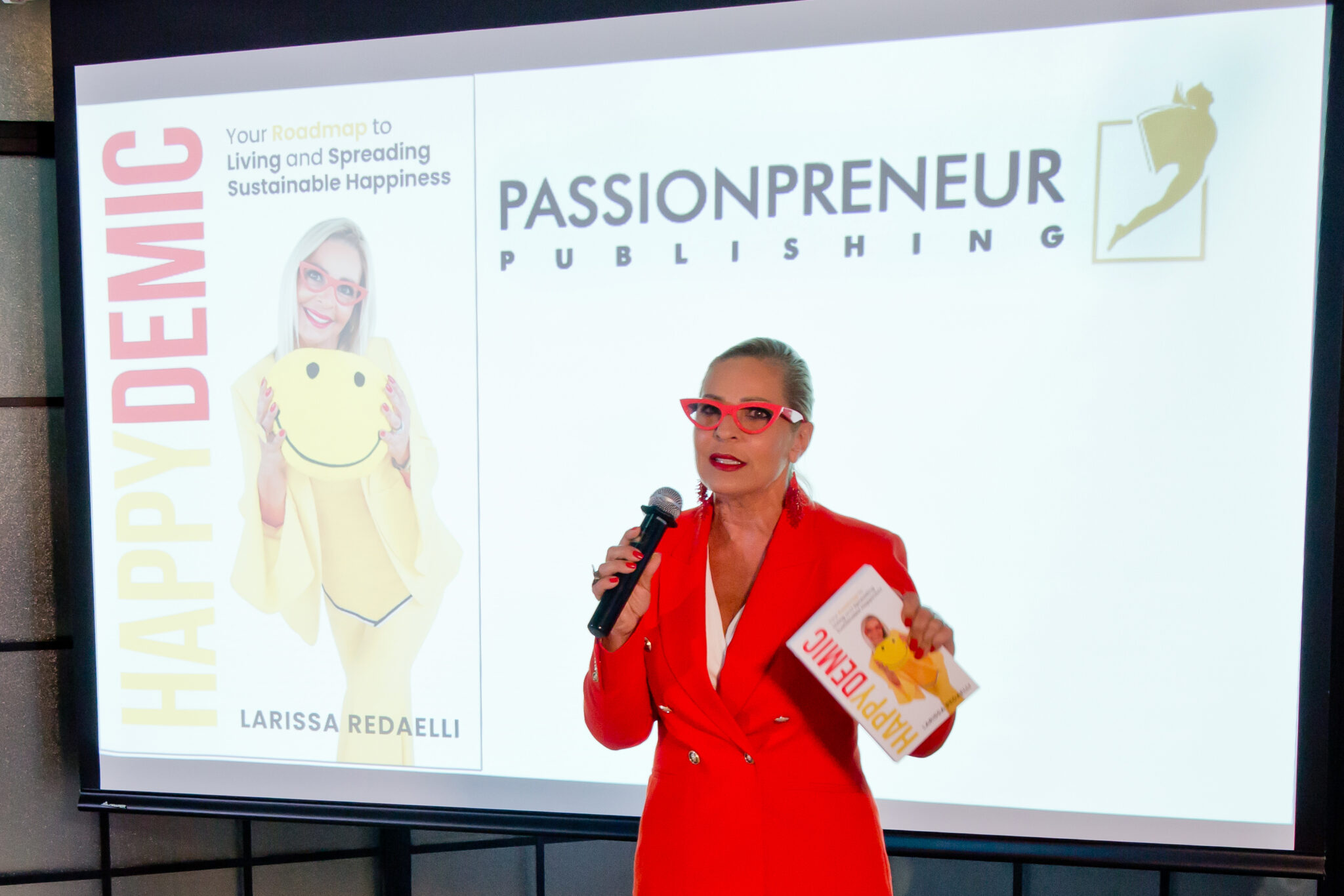
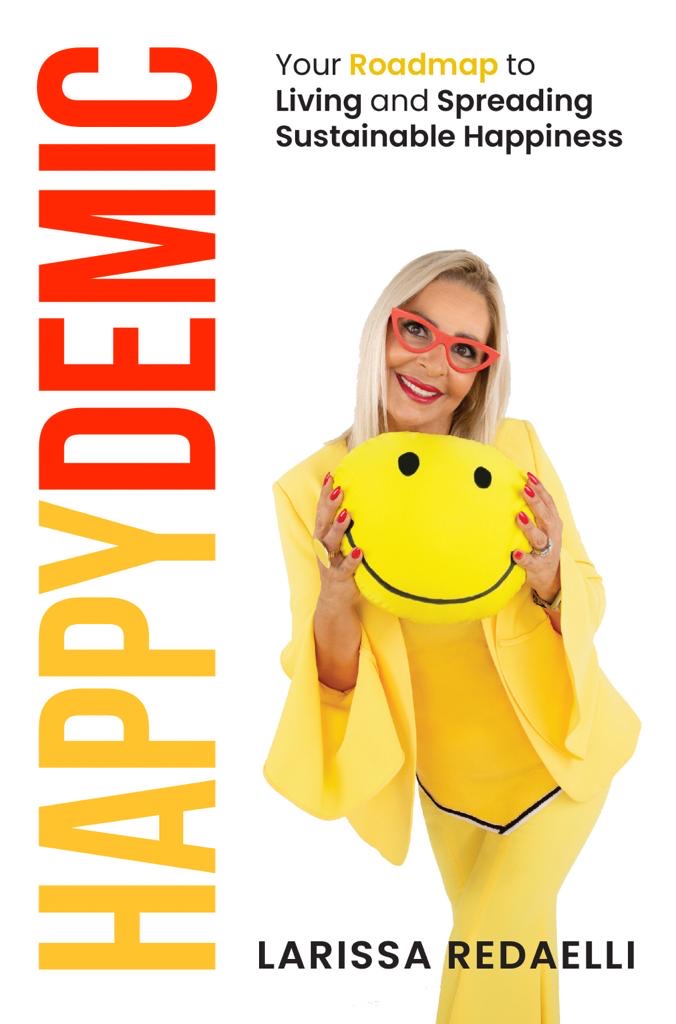
It was during the pandemic that my Happydemic project was born. In response to this “pandemic of fear”, I wanted to launch an “epidemic of happiness”, of resilience, of confidence. I published daily videos, wrote a book, and developed my own method: the “M&M’s” system, a holistic approach to sustainable well-being, encompassing the mental, the emotional, the physical, the social, the digital…
My entrepreneurial journey has taught me that what sets you apart is who you are. In a world saturated with “coaches” and “wellness programs”, what makes the difference is your sincerity, your real-life experience, your humanity. I don’t pass on anything that I haven’t experienced myself. I give what has transformed me.
Even today, I continue to train, to question myself and to grow. But I know that my greatest strength is my ability to touch others, to guide them towards their own light. That’s my mission.
“I then named what I’d been doing for a long time without knowing it: helping companies integrate well-being as the foundation of performance, not as a secondary luxury.“
Can you tell us what the Happydemic Leadership concept means to you, and how you apply it in practice to companies and managers?
Happydemic Leadership is an idea born in the midst of a pandemic. At the time, I saw an “epidemic of fear” taking hold, freezing people in place and severing ties. I wanted to reverse the dynamic: what if, instead, we launched an epidemic of resilience, joy and awareness? A positive contamination.
That’s when I decided to do what I’d been doing for a long time without realizing it: helping companies to integrate well-being as the foundation of performance, not as a secondary luxury. For me, a leader today must do more than just perform: he or she must inspire, reassure and embody balance, even from a distance, even through a screen.
So I developed a method I call “holistic detox”, which works on the mental, emotional, physical and social levels. When you’re doing well in all these dimensions, performance naturally follows. And not just a little performance: a visible, profound and lasting transformation.
In concrete terms, how do I apply Happydemic Leadership?
I always start with a 360° diagnosis of the company: internal surveys, well-being assessments, cultural diagnoses… I look for the “pain points”, then develop solutions on three levels:
- Individual – coaching, training, customized support, no ready-made solutions.
- Team – create a common language, realign values, improve communication, strengthen cohesion.
- Organizational – recasting the corporate culture so that well-being becomes a structural pillar, integrated into KPIs, processes and leadership roles.
I insist: nothing changes sustainably if the top doesn’t lead by example. Leadership cannot be delegated. It is lived, and it is felt in the energy of the whole organization.
I work with CEOs, boards, entire teams, in 100% made-to-measure mode. It’s all about detail, precision and co-construction. And that’s what makes the difference: the transformational experience I propose isn’t theoretical, it’s lived, felt and integrated.
The results? They can be measured, yes, in numbers. But above all in faces: committed employees, vibrant teams, leaders who embody what they preach. And that, for me, is the greatest proof of impact.
What do you think are the ingredients of a fulfilling and sustainable corporate culture today?
For me, a healthy and sustainable corporate culture rests on four essential pillars.
The first is psychological safety. This is fundamental: employees must be able to express themselves freely, without fear of being judged or punished. Even the most marginal voices have their place, because they often carry a part of the truth. If we really care about people, then every voice counts.
The second pillar is the emotional intelligence of leaders. Good leadership is based on deep listening, exemplarity and empathy. These are not options, they are requirements. A leader who doesn’t embody them ends up damaging his team and undermining collective energy.
Thirdly, there must be an alignment of values. It’s not just a question of adhering to the company’s values, but also recognizing those of the individuals who make it up. Everyone comes with their own convictions and needs, and these have to resonate with the collective, otherwise commitment will crumble.
Finally, the fourth pillar is what I call systemic coherence. Holistic well-being – mental, emotional, physical, social, environmental, digital, financial – must be integrated into the company’s DNA, right down to the leaders’ KPIs. It’s not a series of one-off initiatives, but a clear structure, a frame of reference that guides day-to-day behavior.
Just as new employees are given a welcome booklet, they should also be given a wellness guide, so that they know how the company takes care of them, and how they too can become part of this balance.
For me, these are the solid foundations of a truly fulfilling and lasting corporate culture.
“This ambassadorial role is my way of giving back to the school what it has given me in my life, humanly, professionally, deeply.”
You are the EHG Alumni Ambassador for the Middle East. What does this role entail, and why is it important for you to maintain this link with the EHG community worldwide?
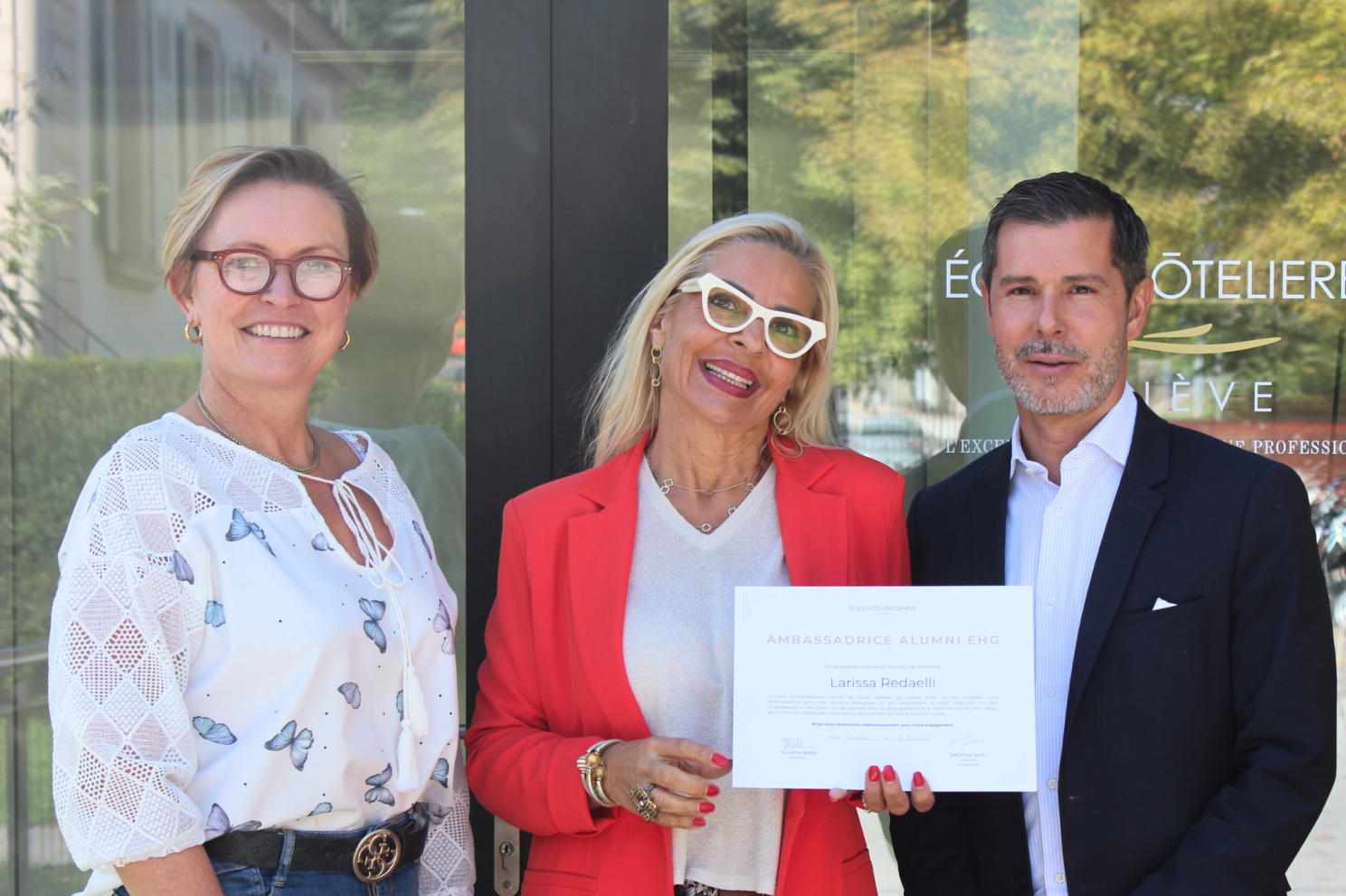
For more than seven years, I’ve had the honor of being the École Hôtelière de Genève’s alumna ambassador for the Gulf, and now for the whole of the Middle East, a region to which I feel deeply attached.
I see this role as a responsibility that I take to heart. I’m a bridge between the school, its graduates and local market opportunities. This means passing on not only the values of EHG, but also the unique spirit I experienced there. This school makes my heart beat; it didn’t just train me professionally, it transformed me profoundly.
In concrete terms, I support young graduates settling in the region, facilitate their professional integration, organize physical or virtual meetings, create links between alumni, and maintain a strong sense of belonging, both to the regional network and to the worldwide EHG community.
This link isn’t just a matter of ambassadors: each alumni has a role to play in bringing this network to life. My aim is also to inspire young people at the end of their studies, who are still hesitating about their future, and to help them discover the EHG as a path of excellence in hospitality and service professions.
This ambassadorial role is my way of giving back to the school what it has given me in my life, humanly, professionally and profoundly.
You have trained and coached many people around the world. What advice would you give to a young EHG graduate wishing to make a positive impact in the workplace?
I’d like to start by saying one essential thing: stay authentic and true to your core values. This is your anchor, your compass in any environment, no matter how demanding.
Next, cultivate listening skills, humility and curiosity. Learn to understand others before imposing your ideas. A good leader always starts with a solid inner balance. You can’t guide others if you don’t know how to guide yourself first.
To me, success is not measured by a title or a salary, but by the positive impact and inspiration you generate around you. Work from the heart, invest in your emotional intelligence as much or more than in your technical skills. Technical skills are important, but human relationships are crucial, especially in professions like hospitality.
I also advise young graduates to surround themselves with people who lift them up, who believe in them, who push them towards excellence. And to know how to set clear limits for those who drag them down or encourage them to conform to what they are not.
Stay aligned with your true self. Be flexible, yes, but never get lost along the way. We’re often expected to be someone else, but the real impact comes from authenticity, inner coherence, and the strength to embody your values, even in moments of doubt.
That’s the essence of what I pass on after more than 30 years of experience around the world. Be yourself. And be a leader from the heart.
What inspires you in your day-to-day work? And what motivates you to continue teaching and training?
What inspires me every day is to see human beings being transformed: when a person unleashes their potential, rediscovers their light and becomes the architect of their own life, it’s a real reward.
Training and coaching are about creating inner micro-revolutions which, in the long term, help teams and entire companies to evolve. I believe deeply in authentic, regenerative leadership, based on well-being, personal responsibility and resilience.
In a world that is losing its bearings, I continue in this profession to help everyone shine from within and take charge of their own lives. For me, that’s the positive epidemic.
Finally, if you could address a message to the "Larissa" who graduated from the EHG in 1992, what would you say to her today with the hindsight and experience you have?
Dear Larissa, be patient and kind with yourself. Your sensitivity is a strength, your resilience an essence. Continue to build your leadership by staying true to your values and your humanity.
You’ll go far beyond what you imagine, changing lives. Believe in the power of self-love, inner alignment and lasting happiness. It’s this light that you’ll spread around you, like a positive epidemic.
I have faith in you. Keep on shining.
Discover our students' success stories