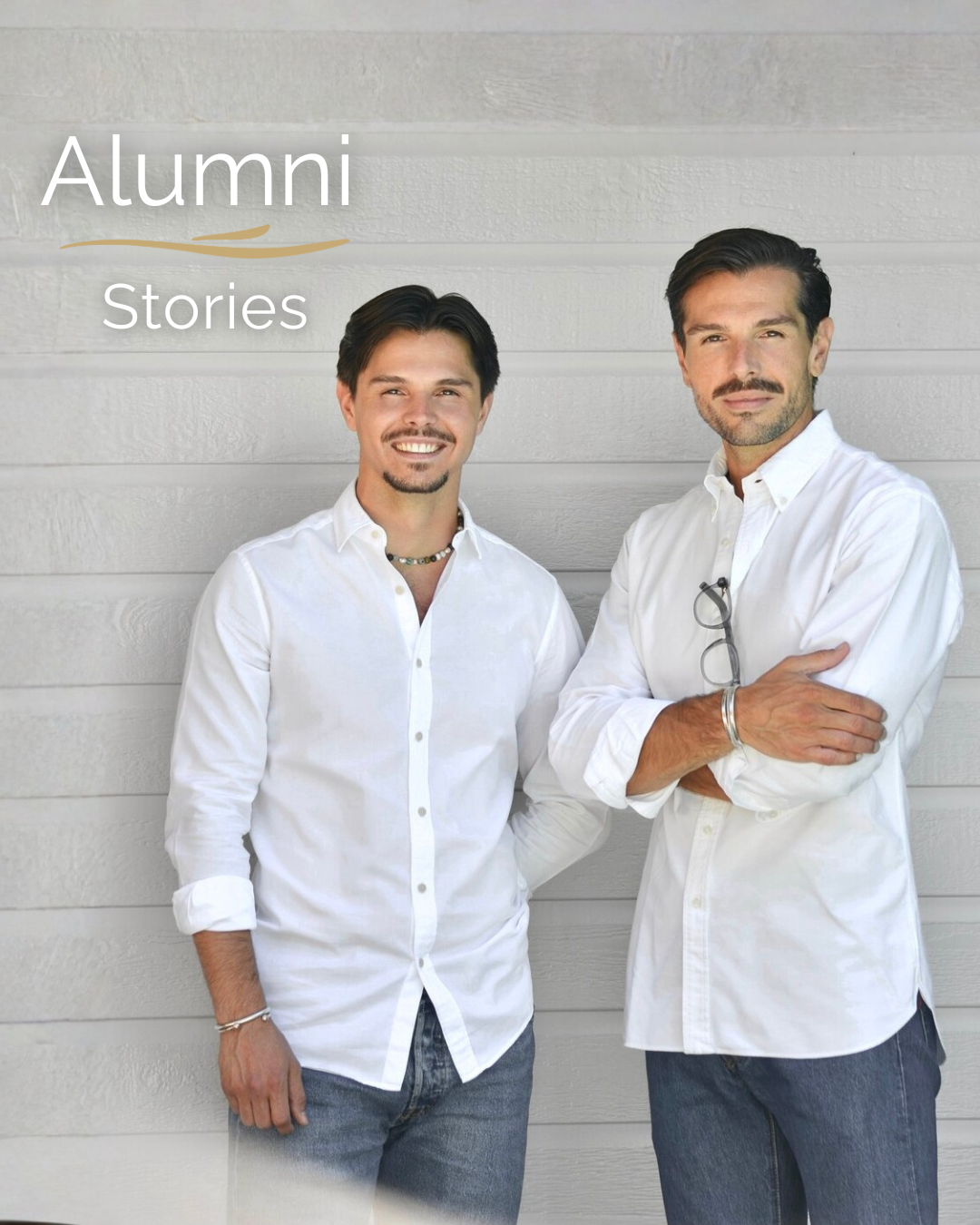
Interview
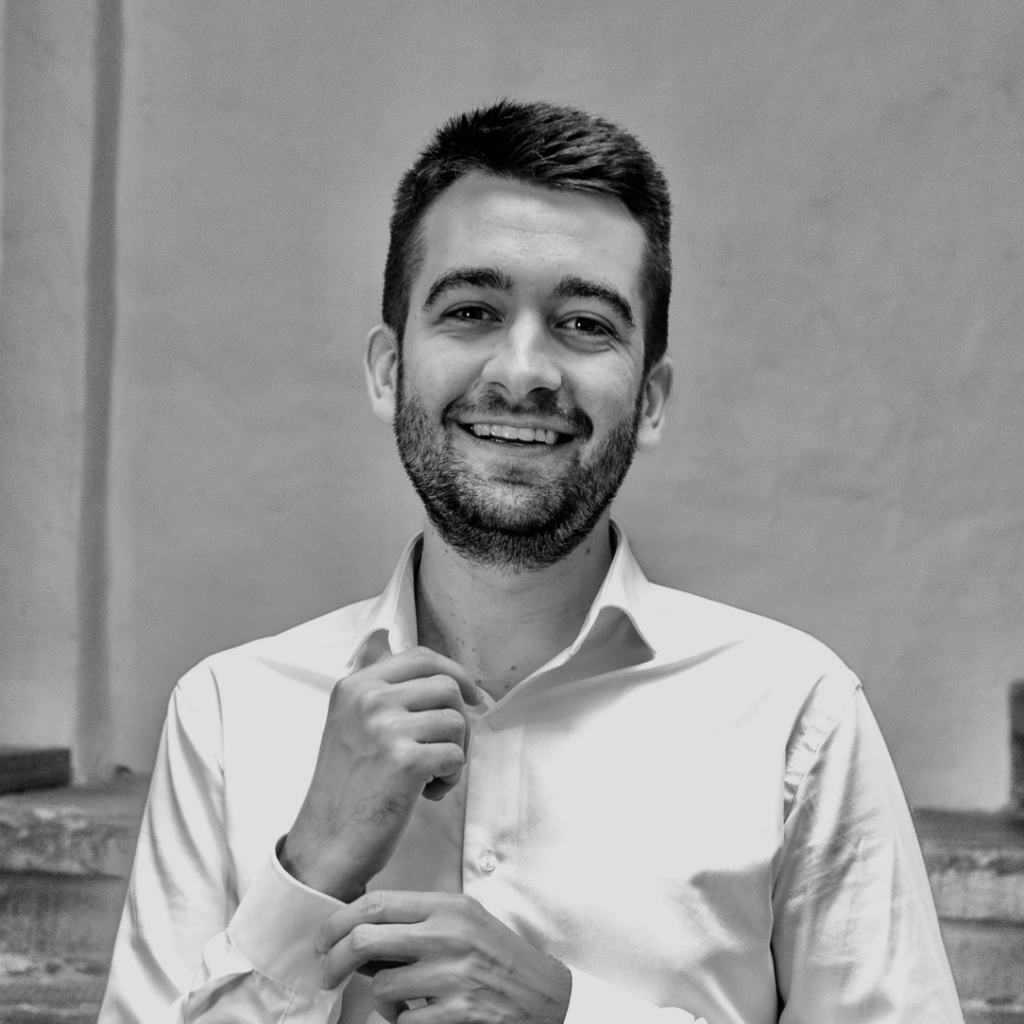
Nicolas Gruber
In this interview, Nicolas shares his inspiring journey, from his first steps in hospitality to the creation of a culinary brand that is already seducing professionals and food lovers alike. He talks about the technical challenges, the importance of surrounding yourself with the right people, and above all, the strength of daring to take the plunge when the entrepreneurial urge becomes too strong.
How do you go from a family memory to a high-end gastronomic brand?
This is exactly what Nicolas Gruber, a graduate of the École Hôtelière de Genève, is experiencing. He is now Hospitality Project Coordinator at the Geneva Tourism & Conventions Foundation and co-founder of Beurre Georges.
It all started with a recipe handed down by his grandfather in the 50s, which over time became much more than a family memory: it became a real project. With passion and perseverance, Nicolas and his brother Raphael Gruber have reinvented this emblematic butter into a premium artisanal product, combining authenticity, know-how and innovation.
Could you briefly describe your career path from graduating from the École Hôtelière de Genève to the present day?
When I decided to join the École Hôtelière de Genève, I was at a time in my life when I needed something concrete. I didn’t see myself as a very academic person, and I felt the need to learn in a different way, through action, in the field, through human contact, and not just through theory.
An internship at the Hôtel Beau-Rivage Genève, in banqueting, was a real eye-opener for me. Despite the long hours, it was an exciting experience. It confirmed my interest in the sector and, above all, consolidated my desire to join ÉHG. What particularly appealed to me about the course was its alternating format: six months of school, followed by six months of internship, each year. This rhythm suited me perfectly. It allows me to integrate the theoretical foundations without overload, while applying them immediately in the field. It’s an extremely formative balance.
What I found invaluable about this curriculum is its ability to prepare us for several possible paths: whether that’s entering the professional world with solid skills, or considering launching our own project. Courses such as business management, catering management and food hygiene are essential, and give us concrete tools to move forward.
Of course, entrepreneurship also means learning on your own, especially when it comes to the external environment: dealing with institutions, funding, foundations and so on. These are skills that you develop on the job. But once you’ve completed your training, you’ll already have all the skills you need to get started, whether in a job or a personal project. And above all, you leave the school with real professional experience, which makes all the difference.
What professional experience have you gained since graduating?
After graduating from EHG, I was lucky enough to accumulate a wide variety of experience, both in the field and in project management. I began my career in operations, notably at PRETTY PATTY, which was extremely formative. Working on a day-to-day basis in a young establishment enabled me to observe and manage the concrete and recurring challenges that can be faced: service problems, kitchen organization, team coordination.
This type of environment has taught me to take a step back, analyze situations objectively and set up continuous improvement processes. Asking the right questions – Why did this service go wrong? Is it an isolated or recurring problem? What can we do to optimize our operations? – has enabled me to develop a more strategic and proactive approach.
Later, I broadened my scope to include event coordination, notably at Watches and Wonders Geneva Foundation, a leading luxury watch show. There, I had the opportunity to work with prestigious brands and coordinate external partners. This experience enabled me to develop my skills in project management, large-scale event organization and communications.
In this type of mission, it’s essential to know how to structure information and circulate it smoothly, whether in terms of vertical communication with managers or horizontal communication between the various parties involved. It’s a balancing act, but an extremely rewarding one.
These combined experiences in the field and in coordination have given me a global vision, both operational and strategic, of the hospitality and events business.
How did the idea of marketing your grandfather's recipe, developed in the 50s, come about?
The idea of launching Beurre Georges has always been there, somewhere inside us. Ever since we were children, this recipe developed by our grandfather in the 1950s has been part of our daily lives. We grew up with this butter on the table, at family dinners and social gatherings, and it always aroused the enthusiasm of our loved ones, friends and neighbors alike. Every time we tasted it, the feedback was unanimous: “But why don’t you market it?”
So that little seed of an idea has always been there. But until now, no one in the family was really in a position to make it germinate. My father and uncle, both very committed to their respective careers, had neither the time nor the energy to embark on a new adventure. So, naturally, Raphaël and I decided to take up the torch, driven by our entrepreneurial spirit and our attachment to this family history.
The economic situation also worked in our favor: we had the right timing, the desire and, above all, the skills to structure a real project. After 6 to 8 months’ work on the business plan, strategy and logistics, we launched Beurre Georges in mid-June. It’s still very early days, but the initial feedback from the market has been extremely positive, which is very encouraging.
Today, we are present in several outlets and we hope to continue to develop the product range. The storytelling around our family history clearly plays an important role: it’s authentic, intergenerational, and full of flavor. Raphaël does a fantastic job of passing it on in the field, particularly in the butcher’s shops where we are distributed. The professionals love it, and find the story easy to tell, which makes our product even more attractive.
Our aim now is to get people used to seeing Beurre Georges on their plates. We know it will take a little time, but we’re confident: the story is appealing, the taste is right, and the adventure is just beginning.
Today, with Raphaël, we’re very proud of what we’ve managed to create: a product faithful to its heritage, carefully modernized, and warmly welcomed by the market.
What were the main technical challenges (formulation, preservation, artisanal production...) involved in bringing this family recipe back to life in the modern era?
One of the biggest challenges at the outset was to find our grandfather’s original recipe. He’d never really formalized it: nothing was written down, everything was done by instinct, with that little extra soul found in family recipes. We’d grown up with this taste in our memory, but we had to rediscover it, decipher it, reconstitute it.
It’s a real work of sensory memory: you remember the taste, the texture, the sensations… but not the exact proportions. What’s more, our grandfather had this habit of always adding a little personal touch, an ingredient or an unexpected gesture, which made the whole thing magical. So we had to do a lot of trial and error, testing different balances of ingredients, adjusting dosages – and all the while keeping in line with the food cost, so that the product could be marketed on a medium scale.
Another major challenge was to find the right balance between craftsmanship and production, as we had a clear vision of the premium positioning we wanted for Beurre Georges. The product had to remain true to its heritage, while meeting the demands of today’s market, particularly in terms of preservation, consistent quality and distribution. This reflection enabled us to build a real guideline for the brand, both in terms of taste and strategy.
The formulation phase lasted around 5 to 6 months, punctuated by numerous test batches. Each time, we had our friends and family taste our products, but especially our grandmother, who played the role of supreme judge. She would often say “no, it’s not right yet”, so we’d start from scratch. There was something emotionally very strong about those moments. They brought us closer as a family, revived memories and recreated a bond around a shared passion.
I remember making it again at home, tasting it, and wondering if it was really that taste, the one I’d experienced with my grandfather. And little by little, we got closer… until the recipe was finally approved unanimously by the whole family.
Today, Raphaël and I are very proud of what we’ve managed to create: a product faithful to its heritage, carefully modernized, and warmly welcomed by the market. And incidentally… our friends couldn’t get enough of the number of test meals, but they enjoyed them too!
How was the balance struck between tradition (original recipes) and innovation (modern techniques, packaging, etc.)?
For us, one of the major challenges of the Beurre Georges project was to strike the right balance between our family heritage and a resolutely modern approach. We didn’t want to betray tradition – our grandfather’s recipe is at the heart of the project – but the product also had to be in line with today’s expectations, in terms of usage, packaging and market positioning.
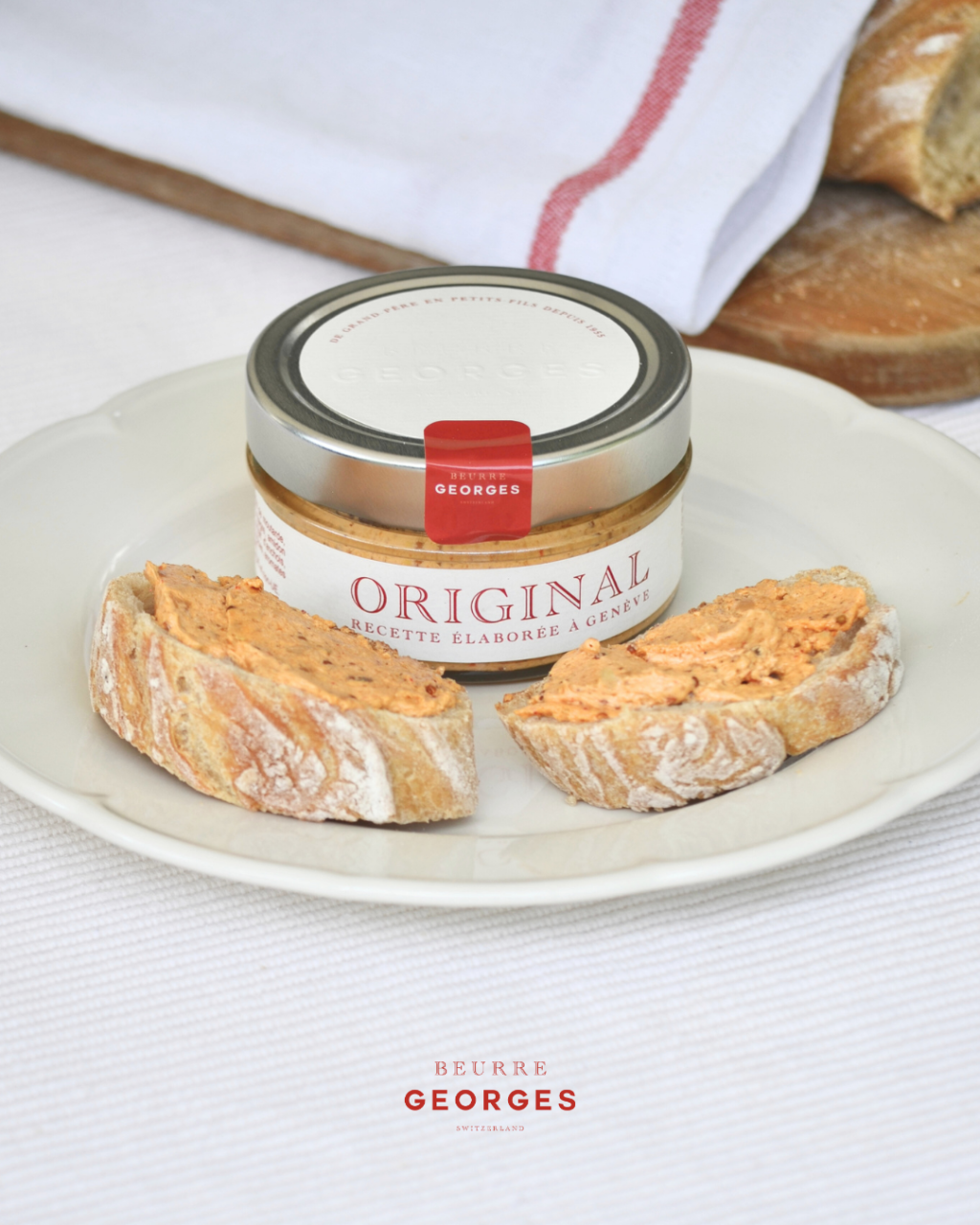
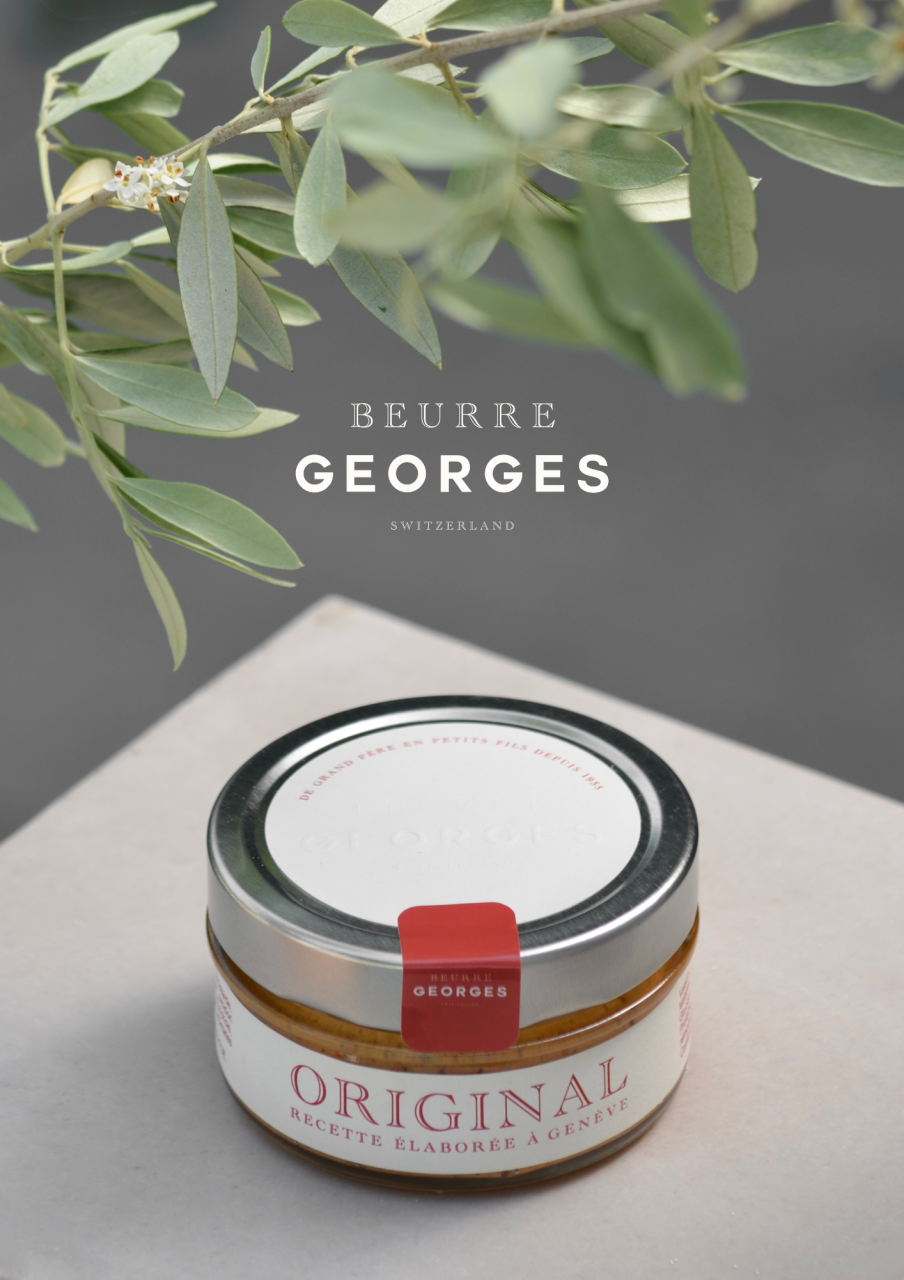
From a very concrete point of view, we already had a certain idea of the container. We’d grown up with this butter in our fridge, and we knew the constraints of the original jar, which was a little too high, making it difficult to get the last few spoonfuls to the bottom. So, from the outset, we wanted to design a jar that was wider than it was tall, with everyday practicality in mind. We even came up with a design reminiscent of caviar tins, to reflect the premium, artisanal feel we wanted to convey.
As for branding, Raphaël and I took the time to find an aesthetic that suited us both. After some debate, we agreed on a clean, elegant identity, focused on the essentials: taste, authenticity and the Swiss origin of the product. We also wanted to raise the profile of Swiss butter, often overshadowed by its foreign equivalents, even though it’s an integral part of our local culinary culture.
The colors chosen, off-white and red, are an obvious nod to Switzerland, but also to the world of craftsmanship and tradition. This choice is in line with our desire to tell a true story, rooted in a territory, but told with contemporary codes.
Finally, we designed the packaging with evolution in mind. The top label reads “Beurre Georges”, and underneath, “l’Original”, in homage to our grandfather. This structure will enable us to develop other recipes or ranges in the future, while maintaining visual consistency and introducing new variations.
In short, every detail has been thought through to combine respect for family know-how with the demands of a contemporary product. In our opinion, it is this duality that makes Beurre Georges unique and strong.
How did your training at the École Hôtelière de Genève help you launch this entrepreneurial project?
My training at the École Hôtelière de Genève was a real springboard for the launch of Beurre Georges. What I remember most of all is the 360-degree view of the restaurant business that the school gives us. You don’t just learn how to manage a service or how to cook: you learn about every facet of the business, from business management to hygiene, from mastering food costs to choosing suppliers and logistics.
These cross-disciplinary skills were essential to the success of our project. Because beyond the recipe itself, creating a food brand means knowing how to navigate between product quality, profitability, regulations, market positioning, and much more. Thanks to the training, I already had the right tools and reflexes to structure our approach.
The practical internships I carried out during my studies also counted enormously. They brought me face to face with the realities of the field, enabled me to observe very different organizational models, and above all to build up a solid base of experience. Once the Beurre Georges project was launched, I was not in uncharted territory: I had already experimented, tested and understood how each link in the chain worked.
Finally, I would say that the École Hôtelière de Genève made me aware of the interconnectedness of all business lines: everything is linked. And this ability to have a global vision, while being able to dive into the details when necessary, is in my opinion a precious asset for any entrepreneur.
More than just a condiment, we see Beurre Georges as a symbol of the art of the table.
How would you describe Beurre Georges' positioning in the Geneva market and beyond?
Beurre Georges is resolutely positioned as a premium product, born of family know-how handed down over 70 years. It’s my grandfather’s legacy that we’re keeping alive: authentic craftsmanship, based on quality, rigor and the right taste. Our ambition is to bring this know-how up to date, adapting it to contemporary gastronomic expectations while preserving its original soul.
More than just a condiment, we see Beurre Georges as a symbol of the art of the table. It embodies a demand we’ve always had at home: to take the time to do things right, to take care of every gesture, every detail. For us, cooking is almost a ritual – a moment of sharing, precision and pleasure.
It’s this spirit that we want to convey through Beurre Georges: an exceptional product, crafted with passion, that invites you to savor, celebrate taste and value quality. In Geneva and beyond, our positioning is based on this alliance between tradition and modernity, authenticity and refinement.
What types of outlets or partners have you targeted for marketing?
When it comes to marketing Beurre Georges, our aim has always been to surround ourselves with partners who share our values and our demand for quality. We have chosen to collaborate with retail outlets and artisans capable of sublimating our product, rather than spread ourselves too thinly over a network that is too large or disconnected from our identity.
Today, we work mainly with butchers, because historically, Beurre Georges is best appreciated with noble meats, such as prime rib or rump steak. This is where our butter has naturally found its place.
We also collaborate with Planète Caviar, a prestigious partner that allows us to explore a different taste register, that of seafood. Beurre Georges goes wonderfully well with salmon, or even blinis – an association we’ve tested and found to work wonders.
In the medium term, we’d like to expand our partnerships to include delicatessens, cheese shops and restaurants that share our passion and attachment to the product. The idea is to work hand in hand with professionals capable of showcasing Beurre Georges with authenticity and creativity.
Our ambition is simple: to offer a noble and versatile product that everyone can make their own. Beurre Georges belongs not only to those who make it, but to those who bring it to life in their kitchens, according to their desires.
What are your aspirations for the future?
It’s a question that’s both simple and complex… but one thing’s for sure, and that is that for the future, I’d like to continue to develop within a company, particularly in the context of my current training with Geneva Tourism. For me, it’s essential to take the time to train in a structured environment, to observe and understand how organizations work, before wanting to set up your own business straight away.
In entrepreneurship, it’s sometimes tempting to want to move fast. But you have to take the time to learn, to confront the realities of the field, to understand the inner workings of a company. Without this learning phase, you run the risk of burning your wings. I’m convinced that a good entrepreneur is also someone who has been able to immerse himself in the best practices of the corporate world before setting out on his own.
In the medium term, my aim is to fully develop Beurre Georges, a project that is particularly close to my heart. The idea is to be able, gradually, to delegate certain operational tasks, particularly in production, so that I can concentrate more on the brand’s strategy, growth and identity. I’d like to see it grow, become firmly rooted in the landscape, and one day be able to devote myself fully to it.
So if I had to sum up my aspirations: to continue learning, to grow professionally, and one day to make Beurre Georges a project in its own right, one that shines as much for its values as for its quality.
Many thanks to Nicolas Gruber for this inspiring and authentic testimonial. His story illustrates the extent to which passion, perseverance and creativity can transform a simple idea into a great entrepreneurial adventure.
With Beurre-GeorgesNicolas brings a family history to life with a bold, modern twist, a fine example of what the entrepreneurial spirit of our graduates can achieve.
Congratulations on your commitment and creativity, and we wish you every success for the rest of your adventure!
Discover our students' success stories