
Professional Bachelor: What Switzerland’s New Title Says About Hospitality Education
Professional Bachelor
Professional Bachelor: What Switzerland’s New Title Says About Hospitality Education
Since 1 October 2026, graduates of Swiss Colleges of Professional Education can add “Professional Bachelor” to their title. For École Hôtelière de Genève, this is above all a long-awaited step: ES education is finally recognised for its true value, and a title that is easier to understand abroad opens more doors for our graduates internationally.
On 3 October 2026, at the École Hôtelière de Genève graduation ceremony, names will be called out one by one, as they are every year. Families will fill the front rows, phones held high, and lecturers will say goodbye to students they first met in their opening semester, some of them unsure, most of them curious.
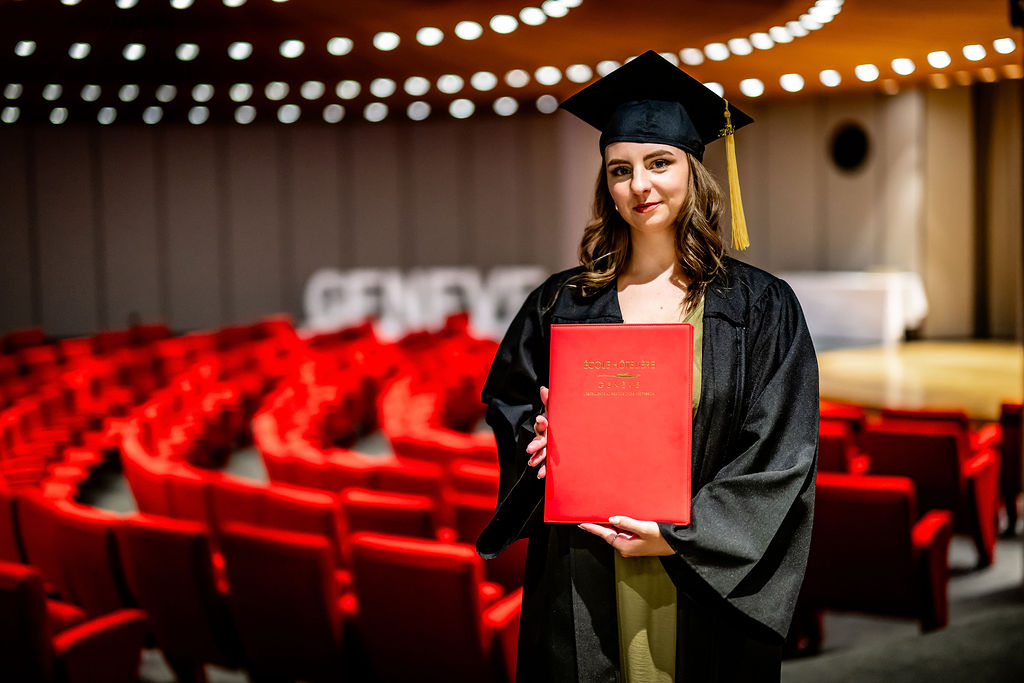
One thing will be different. For the first time, the diplomas of this class will carry a new line: “Hôtelier-Restaurateur diplômé ES, Professional Bachelor”. A few extra words on an official document. For these young professionals, it means a title that people understand at a glance, in Geneva as much as in London, Singapore or Dubai.
What Changed on 1 October 2026
On 24 June 2026, the Swiss Federal Council set 1 October 2026 as the date on which the revised Vocational and Professional Education and Training Act would take effect. Among the new measures, holders of a diploma from an École supérieure (ES) may now add “Professional Bachelor” to their protected title. According to the State Secretariat for Education, Research and Innovation (SERI), the aim is to make clear that these diplomas belong to tertiary education and to give them greater visibility, in Switzerland and abroad.
The reform also protects the name “École supérieure”, known in English as a College of Professional Education. Only institutions offering at least one programme recognised by the Swiss Confederation may now use it. For families comparing options, this is a useful marker: a Swiss hospitality school with ES status delivers training recognised by the state, within a federal framework and with supervised final examinations.
The new title is not reserved for recent graduates either. Anyone who earned an ES diploma before this date may also use it from 1 October 2026. The original diploma stays as it is, but SERI provides a document confirming the right to use the title, and a diploma supplement can be requested. For the many EHG alumni around the world, that is very good news.
Clearer, Not Different
It is worth being precise about what this title changes and what it does not. The ES diploma remains a qualification of Swiss professional education. It does not become a university bachelor’s degree, and the Professional Bachelor is deliberately distinct from degrees awarded by universities and universities of applied sciences.
What it brings is clarity. For years, an international recruiter reading “dipl. ES” on a CV had little idea what it meant. The word “Bachelor” now signals the level of the qualification. The word “Professional” describes its nature: a diploma built around practice and the real needs of the job market. That is exactly what the Swiss Conference of Colleges of Professional Education encourages schools to highlight.
Why Professional Education Is Back in Focus
Switzerland has always given vocational and professional education a central place. What is changing is how the wider world of work sees it now that artificial intelligence is part of everyday life.
The World Economic Forum’s Future of Jobs Report 2025 estimates that 39% of workers’ core skills will change by 2030. The ten skills employers currently consider most essential include resilience and flexibility, leadership, curiosity, empathy and active listening, and service orientation. The same report, drawing on research carried out with Indeed, found that none of the more than 2,800 skills assessed showed a very high capacity to be replaced by current generative AI tools. Skills rooted in human interaction were among the least exposed.
In other words, the better the tools become, the more value shifts towards what they cannot do.
A Growing Industry Rethinking the Place of AI
Tourism has never welcomed so many travellers. According to UN Tourism’s World Tourism Barometer, 1.52 billion international tourist arrivals were recorded in 2025, almost 60 million more than in 2024, and Europe welcomed 793 million of them. Behind each of those journeys are hotel nights, meals, events, and teams who welcome guests.
That growth comes with rapid change. World Tourism Day, held on 27 September 2026, was dedicated to the digital agenda and artificial intelligence. In his message, United Nations Secretary-General António Guterres acknowledged that AI can strengthen small businesses and improve services. He also drew a clear line:
“Technology must serve humanity.”
He called for “a digital future for tourism that is open, inclusive and human”, shaped together with tourism workers rather than imposed on them. For a hospitality school, the message could not be clearer: teach the tools, but never lose sight of the person on the other side of the desk.
What AI Cannot Do at the Front Desk
Picture a guest arriving at a hotel at 11 pm. Their flight was cancelled, tomorrow’s meeting is in doubt, and they are tired and close to the end of their patience. A booking system can assign a room in seconds. It will not notice the tone of their voice, choose the right moment to offer a cup of tea, or sense when it is better to say nothing at all.
This kind of emotional intelligence is not learned from a textbook. It is built during service, through observation, repetition and the occasional mistake. Reading the mood at a table, calming a complaint, keeping a team together during a busy evening: these are skills acquired with real guests and trainers who have done the job themselves.
As Duncan Robertson, Deputy Director of École Hôtelière de Genève, puts it:
“We are delighted that this addition to the title has now become a reality. It gives our students better opportunities internationally, because an employer in London or Singapore can now understand the value of their diploma straight away.”
Educating the Person as Well as the Professional
At École Hôtelière de Genève, founded in 1914 and recognised as an École supérieure for thirty years, this conviction shapes the entire programme. From the first semester, students on the Swiss ES Diploma in Hospitality Management work at the Geneva Marriott Hotel and the Crowne Plaza Geneva, two partner hotels where they learn the job alongside working teams. Throughout the first year, theory and practice move forward together: what students learn in class is put into practice straight away, with real guests. They also serve at the Vieux-Bois training restaurant, complete internships in industry, work in small groups and learn to lead a team as confidently as they read a profit and loss statement.
Artificial intelligence is part of the curriculum, because a future manager needs to use it with good judgement. It remains a tool, though. The heart of the training is still the relationship: understanding a guest, motivating a colleague, making a decision under pressure and standing by it.
What It Means for You
For a young person considering a hotel management diploma in Switzerland, the Professional Bachelor offers a qualification recognised by the state, easy to read internationally and firmly connected to the workplace. For parents, it provides a reliable reference point in an education landscape that can be hard to compare.
For professionals already in work, the reform also makes continuing education at Colleges of Professional Education more flexible and modular. EHG offers three hybrid postgraduate programmes designed for people who want to progress without leaving their job: Hotel Management, Luxury Hospitality and Product Management, and Creative Event Conceptions & Organisation. Each combines one year of classes, online and on campus, with a six-month business project. The school’s certificates, meanwhile, allow professionals to deepen their expertise in a specific area.
On 3 October, as the new graduates leave the ceremony, their title will say a little more clearly who they are: professionals trained through practice, able to do what no machine can: create moments people remember, and turn a stay, a dinner or an event into an emotion guests carry with them long after they have left.

